

24/7 Emergency · Chino Hills, CA
Residential Water Damage Restoration in Chino Hills, CA
Your home is where the disruption of water damage hits hardest — the family photos, the floors you chose, the routine that stops when a room is torn up. We treat a residential loss like it's our own house: we move fast, we're careful with your belongings, and we keep you informed at every step.
Serving Chino Hills & the Inland Empire · Open 24 hours — 7 days a week
From a small under-sink leak to a whole-floor flood, we handle the entire job — extraction, drying, mold prevention, and repairs — and we work directly with your homeowners insurance so you're not managing the claim alone.
Common household water damage
- Burst or leaking supply lines under sinks, behind toilets, or in walls
- Overflowing washing machines, dishwashers, tubs, or toilets
- Water heater ruptures and refrigerator line leaks
- Roof and ceiling leaks during winter storms
- Slab leaks under the foundation of older homes
Our residential restoration process
A residential loss is handled from first call to final walkthrough:
- 1
Inspection & plan
We assess the damage, map hidden moisture, and walk you through the plan and timeline in plain language.
- 2
Extraction & drying
Standing water comes out, then monitored drying brings your home's materials back to dry standard.
- 3
Mold prevention & cleaning
Antimicrobial treatment and HEPA filtration keep the loss from turning into a mold problem.
- 4
Repairs & walkthrough
We restore flooring, drywall, and paint, then walk the finished work with you and hand over your claim documentation.
What affects the cost
Every home is different, but residential cost tracks:
- Size of the loss
- One room versus multiple rooms or floors sets the equipment and labor.
- Water category
- Clean water is simplest; gray or black water adds handling and disposal.
- Finishes affected
- Hardwood, tile, custom cabinetry, and upstairs ceilings cost more than carpet to restore.
- Time before response
- The sooner we start, the less secondary damage and the lower the total.
We never quote a water loss sight-unseen. Call (201) 277-9344 for an honest, on-site assessment.
Need residential restoration in Chino Hills?
Tell us what happened — a live person answers any hour and gets a crew moving.
Answering 24/7 60-min response target Licensed & insured
Living around the equipment while your home dries
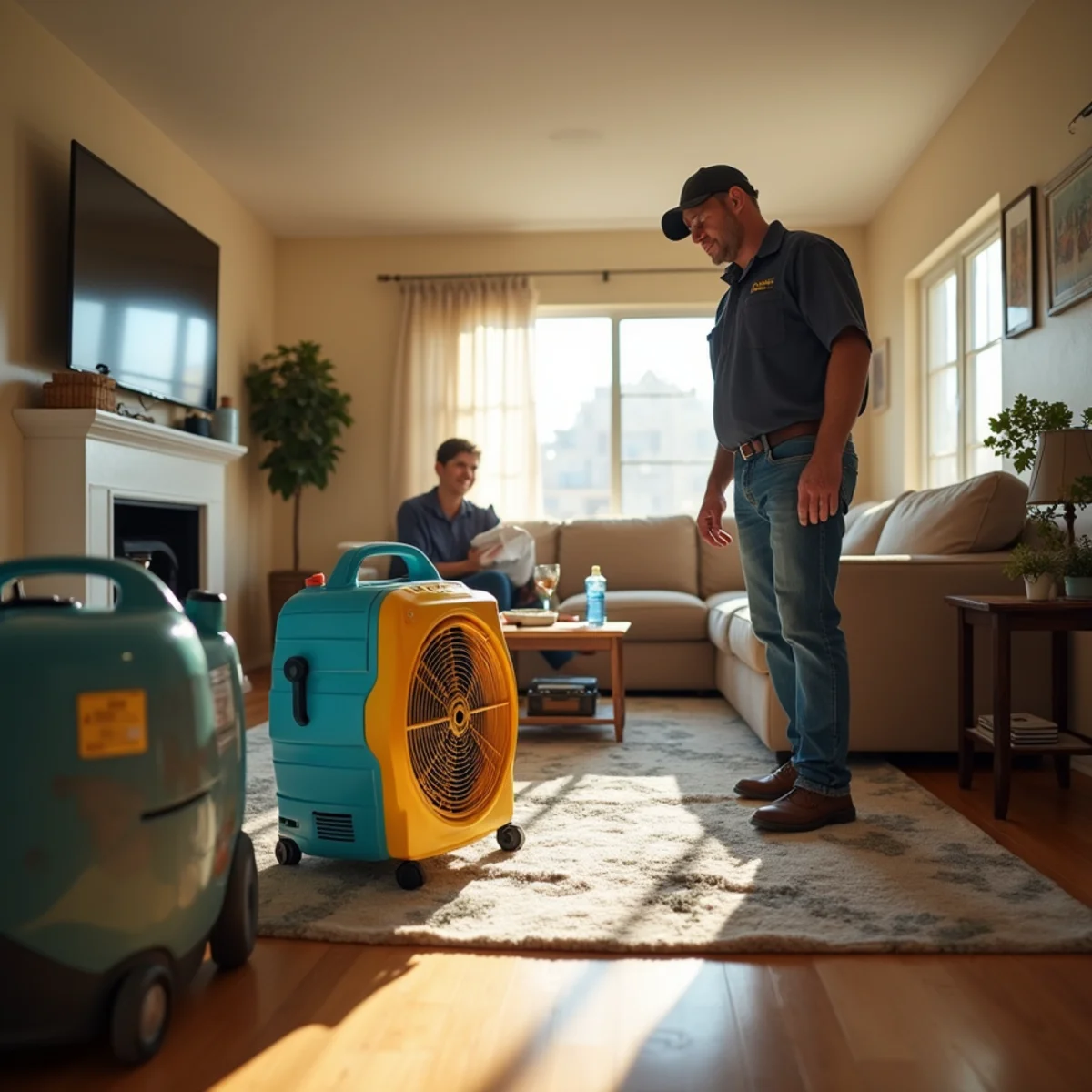
Drying equipment is loud and it takes up real floor space, and most families still have to live in the house, or part of it, while it runs. We think about placement with that in mind — keeping at least one clear path through the house, leaving a bathroom accessible, and consolidating equipment into fewer rooms when the drying plan allows it, rather than spreading fans through every hallway just because the room technically got a little wet somewhere in it.
Cords get secured and taped down along walls rather than run loose across walkways, especially with kids or pets in the house, and we'll talk through the noise and the schedule honestly so you know what a few days of this actually looks and sounds like before it starts. If something about the setup genuinely isn't working for your household — a bedroom you need access to overnight, for instance — tell us and we'll look at what we can adjust.
Protecting what can't be replaced
Structural drying equipment is built for framing and drywall, not for a shoebox of family photographs or a water-damaged box of documents, so we handle those separately by hand rather than letting them sit in the general drying area. Photos, important documents, and keepsakes get set aside as soon as we spot them, because the standard approach to drying a house is often too rough, or simply too slow, for something that can't be reprinted or replaced. We'd rather ask which box matters most than assume nothing in the room is irreplaceable.
Depending on what it is and how wet it got, that might mean gently air-drying individual photos separated so they don't stick together, or freezing water-damaged documents to stop further deterioration until there's time to address them properly. It's a slower, more careful process than running a dehumidifier, and it's not something we rush just to close out the job faster. If something matters to your family beyond its dollar value, tell us — we'll treat it that way, and say plainly if something is too far gone to save rather than string you along.
Small mistakes that make a household water problem bigger
The most common one is deciding a leak is minor because the puddle looks small. A slow drip under a sink or a small ring on the ceiling can represent hours or days of hidden moisture behind what you can actually see, and treating it as a wipe-it-up problem instead of calling someone delays the point where real drying starts. By the time it's obviously a bigger problem, the cost and the timeline have both grown along with it. A five-minute call when you first notice something is almost always cheaper than the wait-and-see approach.
We also see well-meaning attempts to fix things solo — a box fan aimed at wet carpet for a few days, a bucket under a ceiling drip with no plan beyond emptying it. Those buy a little time but don't dry anything to a verified standard, and they can create a false sense of "handled" that delays the call that actually solves it. If you've already tried something like this before calling us, just tell us — it helps us understand what we're walking into.
What your family gets at the end of the job
The final walkthrough is for you, not just for our file. We walk through every room that was affected, point out what's new versus restored, and answer whatever questions come up as you're looking at your own space again — not rushed, and not over the phone. If something doesn't look or feel right to you, that's the moment to say so, before we call the job finished. We'd rather spend an extra fifteen minutes at the end than have you call back next week with a question we could have answered on the spot.
You also get a documentation package built for a household, not a spreadsheet: before-and-after photos, a plain-language summary of what happened and what was done, moisture verification, and an itemized invoice formatted the way your insurer expects. If repair work included a warranty, that information goes in the same file. It's everything you'd want on hand if a question comes up next year, or if you're ever selling the house and someone asks what happened in that room. It's the same file we'd want if the situation were reversed.
Why Chino Hills chooses us for residential restoration
When residential restoration is on the line, the details decide the outcome. Here’s what you get with our local crew:
24/7 live response
A real person answers any hour, with a 60-minute arrival target across Chino Hills.
Licensed, insured & IICRC-certified
A California restoration contractor with trained technicians and full coverage.
Dried to a verified standard
Daily moisture logs prove the job was done right — not dried by guesswork.
Insurance claim advocates
We document the loss and deal with your adjuster directly, Xactimate estimates included.
Local to Chino Hills
We know these hillside slab homes, the hard water, and the Santa Ana storms firsthand.
Where we provide residential restoration
We’re based in Chino Hills and deliver residential restoration across the Inland Empire and North Orange County — from Chino Hills and Chino to Diamond Bar, Corona, Yorba Linda, Brea, and the neighborhoods in between. Fast local dispatch means the water spreads less and your loss stays smaller.
Residential Restoration FAQs
Do you handle small leaks too, or only big floods?
Will you help with my insurance claim?
Can I stay in my home during the work?
Is it safe to have my kids and pets around while the drying equipment runs?
Can you save water-damaged photos or important documents?
Is the repair work covered by a workmanship warranty?
Related Services
Need residential restoration in Chino Hills?
Our Chino Hills crews are on call 24/7 with a 60-minute response target. Call now or request your free estimate.