
Insurance & Cost
Slab Leak Repair vs. Whole-House Repipe: What Each Costs and What Insurance Covers
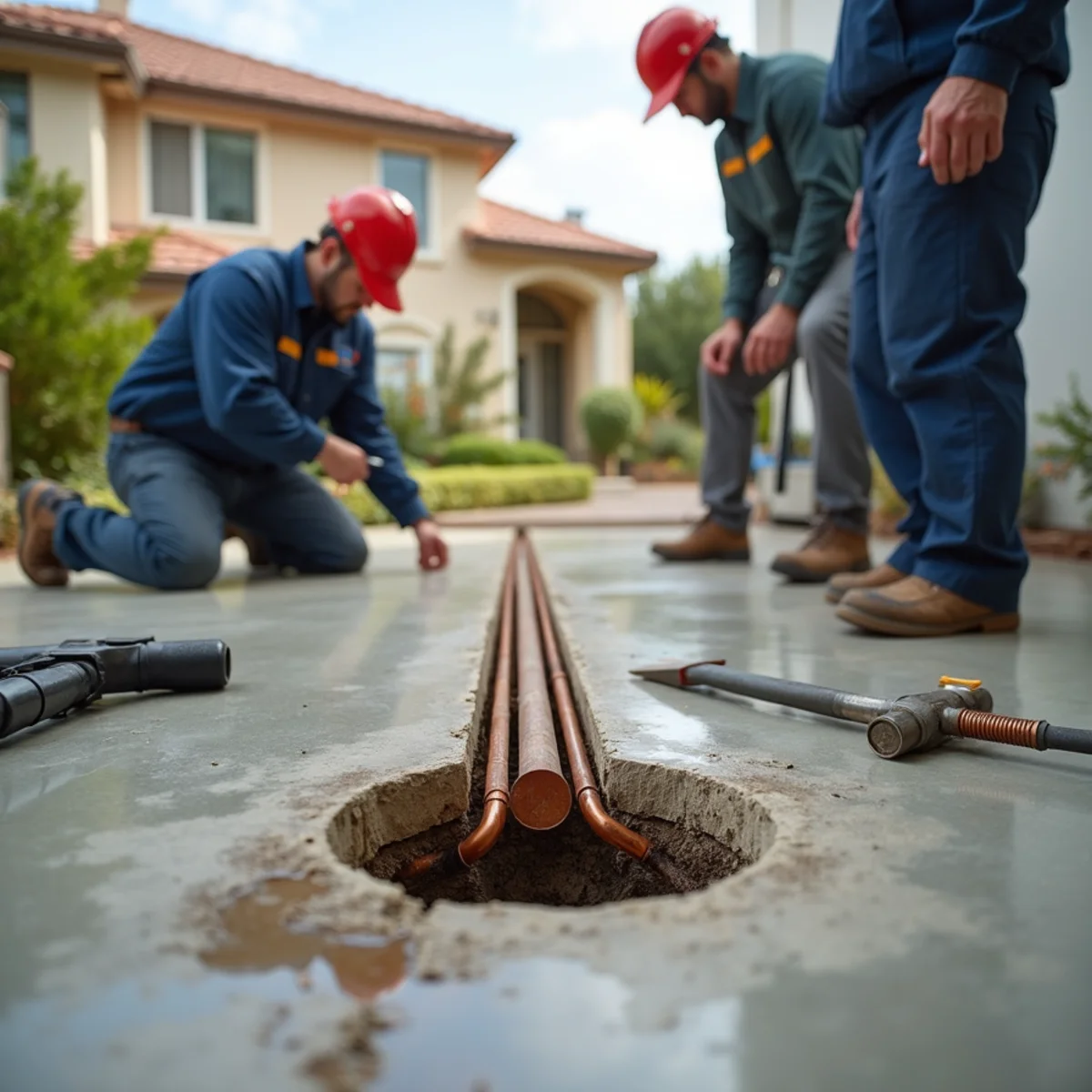
A slab leak forces two separate decisions at once: how do you stop the water, and how do you pay for it? The plumbing fix and the water damage it caused are actually two different cost categories with two different insurance answers — and mixing them up is the most common way homeowners misjudge what they'll owe.
Here's how spot repair, rerouting, and full repiping compare, and where insurance typically does and doesn't step in.
Why This Is Showing Up So Often in Chino Hills Right Now
Much of Chino Hills — Butterfield Ranch included — was built in the 1980s and '90s on slab-on-grade foundations with copper supply lines running through or under the concrete. That copper is now 30 to 40 years old, squarely inside the window where pinhole corrosion starts showing up, accelerated by the Inland Empire's hard water working on the pipe from the inside. If one house on a street develops a slab leak, the identical-age plumbing next door usually isn't far behind.
Option 1: Spot Repair
A spot repair accesses the exact point of failure — sometimes through the slab, sometimes by rerouting a short section above it — and fixes just that section of pipe. It's the least invasive and least expensive of the three options, but it comes with a real limitation: it fixes this leak, not the pipe's overall condition. If the rest of the copper is the same age and exposed to the same water, a spot repair can buy you years, or it can be the first of several repairs as more pinholes develop nearby.
Option 2: Reroute
Rerouting abandons the damaged section of under-slab pipe entirely and runs new line through the attic, walls, or exterior instead. It costs more than a spot repair because there's more new pipe and often more drywall work, but it avoids repeated slab penetrations and gets that specific line off the ground for good. It's a middle option: more durable than a single spot repair, less disruptive than a full repipe.
Option 3: Whole-House Repipe
A full repipe replaces all of the home's supply lines, typically with copper or PEX, regardless of which line actually failed. It's the most expensive option by a wide margin and the most disruptive — expect multiple days of access through walls and ceilings. It's also the only option that resolves the underlying issue rather than one symptom of it. For a home with aging copper and more than one leak in its history, a repipe is often the option that stops the pattern instead of managing it leak by leak.
We won't put a specific number on any of these three here, because the honest range is wide and depends entirely on your home's layout, accessibility, and the plumber's method. Get quotes from a licensed plumber for the pipe work itself; we handle the water damage side and can tell you what the leak has already cost your home before you decide how to fix the source.
What Insurance Actually Covers Here
This is where the two halves of the job split. Most homeowners policies treat the pipe itself as a maintenance item — the cost to repair or replace the failed pipe is commonly excluded, similar to how a policy doesn't pay to replace a worn-out roof. But the water damage the leak caused is a different story: if the leak was sudden and accidental rather than a long-ignored problem, many policies cover the resulting damage to flooring, drywall, and cabinetry, and often the reasonable cost of accessing the pipe through the slab or a wall, sometimes called tear-out coverage. In practice, that can mean your claim pays for cutting into the slab and restoring the floor around the repair, even while the pipe repair invoice itself lands on you. Every policy is written differently, so this is a conversation to have directly with your adjuster with our documentation in hand — we're not making coverage decisions on your carrier's behalf.
The Water Damage Side of the Bill
Whichever repair option you choose, the water that already escaped needs professional attention. Slab leaks are almost always Category 1 clean water at the source, but by the time they're discovered they've often wicked into flooring, baseboards, and drywall — and industry data puts water damage restoration in the range of $3 to $7.50 per square foot, depending on materials and how far the water traveled. A leak caught early, before it spreads past the immediate area, sits at the low end of that range. One that's been running for weeks under tile or hardwood costs more to dry and repair, which is one more reason a warm spot on the floor or an unexplained water bill spike deserves a same-week look, not a wait-and-see.
How to Decide Which Repair Is Right
Start with detection, not demolition. Non-invasive leak detection pinpoints the exact failure before anyone opens the slab, which matters for every option above — you can't reasonably choose between a spot repair and a repipe until you know whether this is an isolated failure or a symptom of pipe-wide corrosion. A plumber who's found three prior pinhole repairs on your service line is giving you different information than one confirming a single, isolated leak.
Once the plumbing decision is made, we handle the slab leak water damage side: drying the slab and surrounding structure, restoring flooring and drywall, and documenting the loss the way your insurer expects. Call (201) 277-9344 if you're seeing signs of a slab leak — a warm spot on the floor, running water with everything off, or a water bill that jumped — and we'll help you sort out what's actually happening before you commit to a repair path.
Frequently asked questions
Does insurance ever cover the pipe repair itself?
How do I know if I need a repipe instead of a spot repair?
Can you tell me if it's a slab leak before I call a plumber?
Water Damage Chino Hills
A local, IICRC-certified restoration team serving Chino Hills and the Inland Empire 24/7. Water damage right now? Call (201) 277-9344.