
Commercial & Property
Water Damage in a Retail Space: A Response Plan for The Shoppes at Chino Hills Tenants
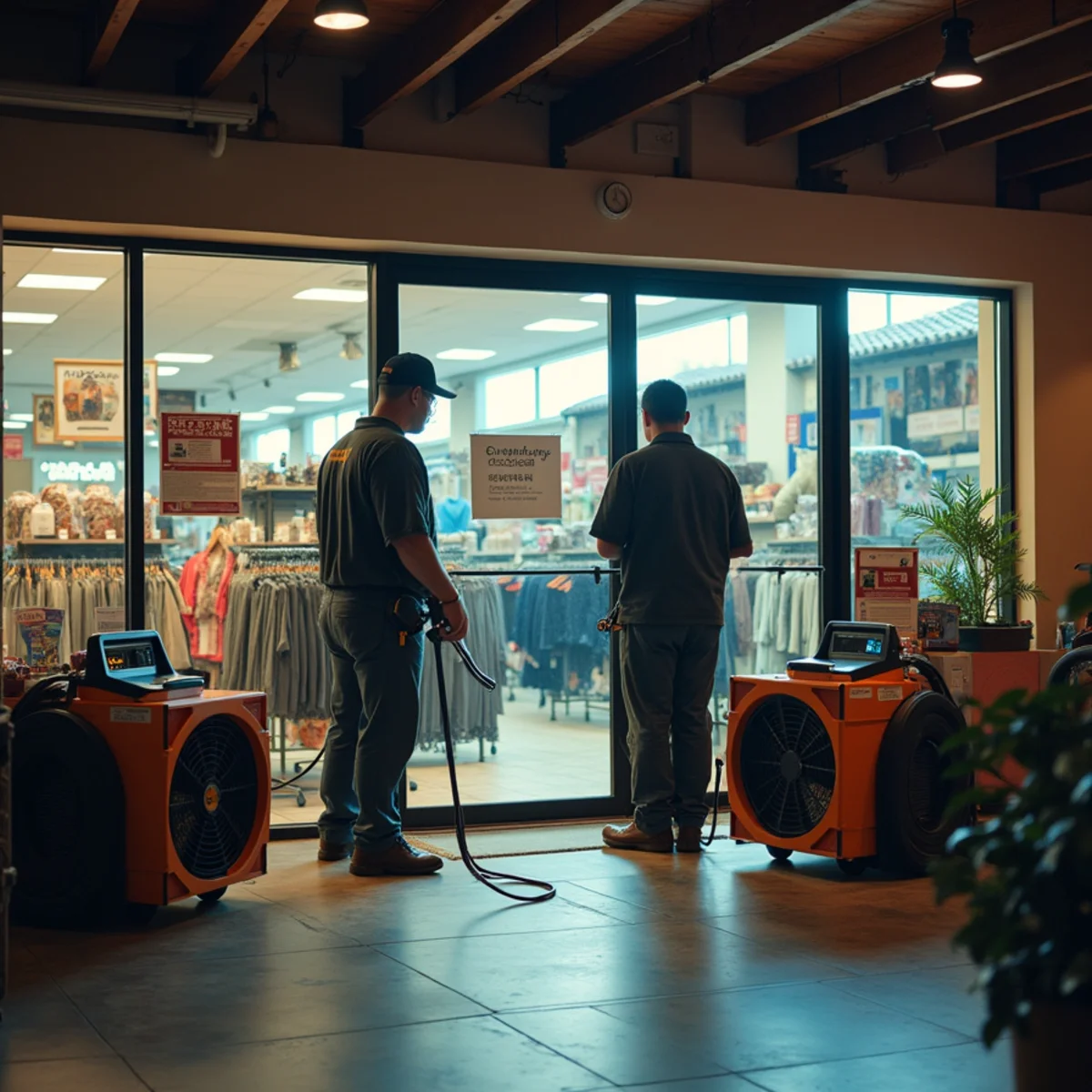
A water event in a retail space is a different kind of emergency than one in a home. Nobody's evacuating overnight — the store usually needs to open again tomorrow, with inventory that has real cash value sitting on shelves and a landlord, insurer, and possibly a corporate office all expecting a clear account of what happened. Whether you manage a suite at The Shoppes at Chino Hills or any other retail space in the city, having a response plan before something goes wrong is what keeps a bad morning from turning into a week of lost revenue.
Here's a response plan built specifically for retail tenants and the property managers who support them.
Step 1: Stop the source, if you safely can
If the water is coming from something inside your suite — a broken fixture, an overflowing sink in a back room, a leaking water heater — and you can identify and reach the shut-off without stepping into standing water near electrical, do it. If the source is a shared building system (a sprinkler head, a roof drain, a line serving multiple units), that's a call for the property manager or building engineer, not something a store manager should try to isolate alone. Know ahead of time which category your space falls into, because that determines who you call first.
Step 2: Call your restoration company and your property manager — in parallel, not in sequence
Don't wait for one call to finish before making the other. Property managers need to know immediately so they can check whether the source affects neighboring units and coordinate any building-wide response. At the same time, getting a commercial restoration crew moving is what actually limits how much of your space and inventory gets damaged. The two calls solve different problems, and neither should wait on the other.
Our commercial water damage restoration team is built for exactly this — retail suites, multi-tenant buildings, and property managers who need a crew that shows up with the equipment and capacity to match the space, not a residential-sized response scaled up on the fly.
Step 3: Protect inventory before you protect the fixtures
In a retail space, inventory is usually the most valuable thing in the building, and it's also the most portable. Move stock off the floor and away from the affected area first — onto shelving, a back counter, or into an unaffected storeroom. Cardboard packaging wicks water fast, so anything boxed near the water should be treated as higher-risk even if it looks dry on the outside. If product has already gotten wet, don't make a keep-or-toss call yourself under pressure; document it and let your insurance adjuster and restoration team weigh in, since some claims process differently depending on whether damaged inventory was disposed of before it could be assessed.
Step 4: Document before, during, and after — not just the damage itself
Commercial claims move faster and cleaner when the documentation is thorough from the start. That means:
- Photos and video of the water, the source, and the affected inventory and fixtures, taken before anything is moved or cleaned up.
- A written timeline: when the water was discovered, when the source was stopped, when each call was made.
- Receipts for anything purchased for emergency mitigation — many are reimbursable under a commercial policy.
- Daily drying logs and moisture readings from your restoration crew once mitigation starts, which your insurer and any corporate risk-management office will expect to see.
This is also the point where working with a crew that documents to a commercial standard — not a residential one — actually matters. Adjusters handling a business-interruption claim expect a different level of detail than a homeowner's claim, and having it from day one avoids a slower, more contentious claims process later.
Step 5: Plan around minimizing closure, not just fixing the damage
Every day a retail space stays closed is lost revenue, and that reality should shape the restoration plan itself. Ask your restoration crew whether extraction and drying can happen in phases that let you reopen part of the store while another section dries, whether equipment can run overnight or before hours to avoid disrupting business, and what the realistic timeline looks like for the specific materials involved — commercial flooring, drywall, and fixtures dry differently than a home's finishes. A crew that's used to commercial work will have a straight answer to all three questions instead of a generic estimate.
Step 6: Loop in your team before the next shift
Employees showing up to a wet or closed store need clear direction — where to park, whether the store is opening at all, and what not to touch if equipment is running. A short written update sent before the next shift, even a text message, keeps staff from walking into a space with air movers, cords, and wet flooring without warning, and keeps the story consistent if customers ask what happened.
Building this into a standing plan, not a one-time response
Retail centers near Village Oaks and throughout Chino Hills' commercial corridors see the same categories of water event repeatedly — sprinkler discharge, roof and HVAC leaks, restroom and break-room plumbing failures. If you manage more than one location, or you're a property manager responsible for multiple tenants, it's worth having this response plan written down and shared before you need it, with our number already saved rather than searched for during the emergency itself.
Dealing with water in your retail space right now, or want to put a response plan in place before you need one? Call (201) 277-9344 — we're available 24/7 and built for exactly this kind of commercial response.
Frequently asked questions
Who should a retail tenant call first — the landlord or a restoration company?
Can you work around our store hours to limit closure?
What documentation does a commercial water damage claim need?
Water Damage Chino Hills
A local, IICRC-certified restoration team serving Chino Hills and the Inland Empire 24/7. Water damage right now? Call (201) 277-9344.