
Emergency Response
Water Heater Flooded the Garage: Emergency Steps Before Help Arrives
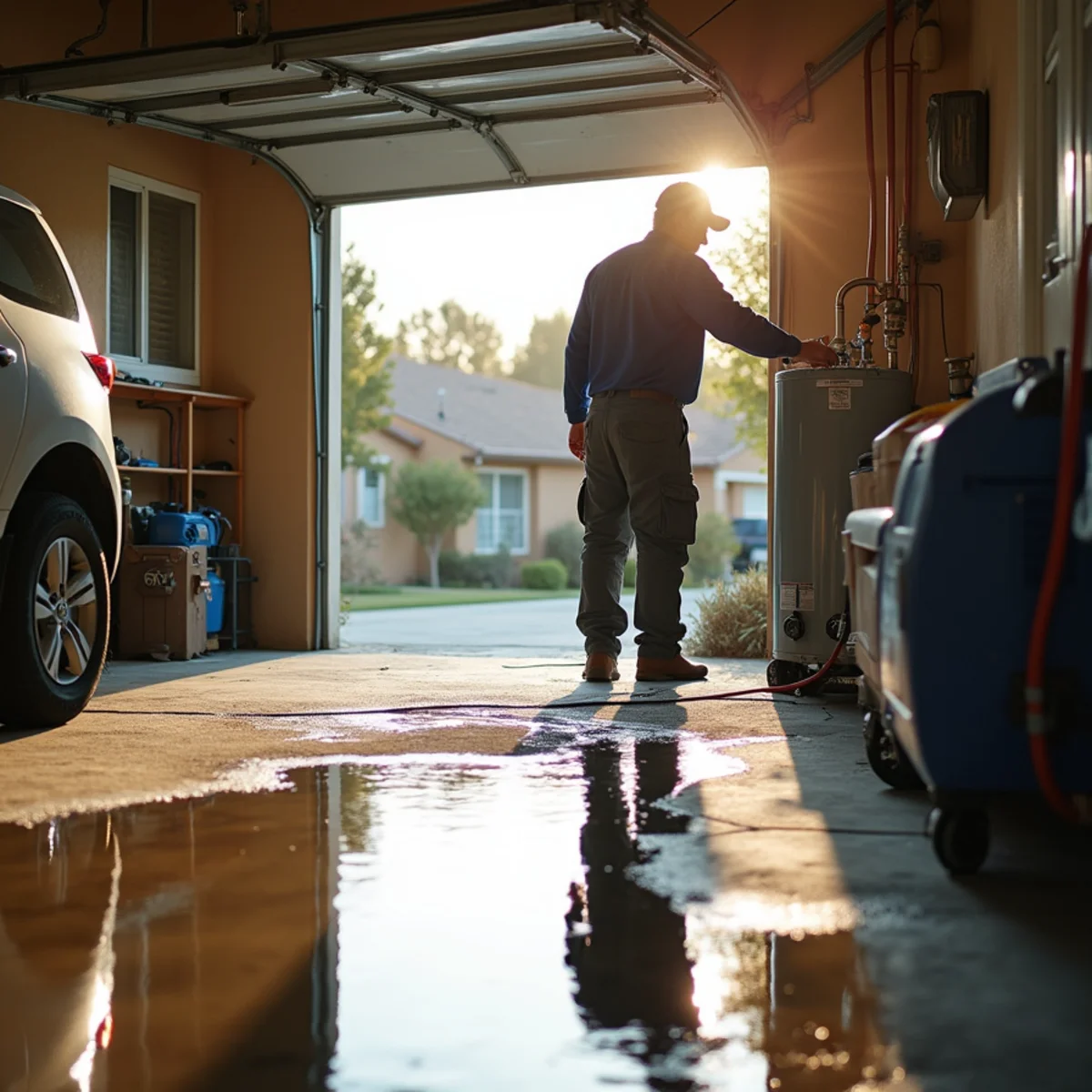
Most Chino Hills water heaters live in the garage, and when one fails, it doesn't drip — it dumps. A 40- to 75-gallon tank that splits at the seam or blows a fitting can put a wall of water across the garage floor in minutes, and garages aren't built to contain it. The water finds the path of least resistance: under the drywall base plate, through the threshold into the house, or straight into the door track leading to the kitchen or laundry room.
Here's what to do right now, in order, before anyone drives out to help you.
1. Shut off the water supply to the tank
Look for a shut-off valve on the cold-water inlet pipe at the top of the water heater — it's usually a small lever or wheel handle. Turn it a quarter turn or until it stops. If that valve is corroded, stuck, or you can't find it, go to your home's main water shut-off valve and close that instead. Stopping the source is the only thing that actually stops the flood; everything else is just managing what's already on the floor.
2. Kill the power or the gas — don't skip this
An electric water heater sitting in standing water is a shock hazard. If you can safely reach your breaker panel without stepping in water, switch off the breaker labeled for the water heater. For a gas unit, turn the gas control valve at the tank to "off" — do not attempt to relight the pilot yourself once the base has been sitting in water, since flooded gas controls and thermocouples need to be inspected before they're used again.
3. Stop the water from reaching the house
Garages typically sit a couple of inches lower than the interior threshold, which buys you a little time, but not much once water pools deep enough. Grab towels, a shop vac if you have one, or even a rolled-up bath mat and block the doorway into the house. If water has already crossed into a hallway or laundry room, mop up what you can and get fans or a dehumidifier running only if the outlets nearby are dry and safe to use.
4. Move stored items off the floor
Garages double as storage, and cardboard boxes, holiday decorations, and anything with particleboard or untreated wood will wick water fast and start warping or growing mold within a day or two. Lift what you can onto shelving or a workbench. Anything porous that's already saturated — cardboard especially — is usually not worth trying to save.
Check for a drain pan — and where its drain line runs
Many garage-installed water heaters sit inside a shallow metal or plastic drain pan with its own small drain line running to the exterior wall or into a floor drain. That pan exists to catch exactly this kind of failure — but only if its drain line is actually clear. A surprising number of "sudden" garage floods are really a slow leak the pan quietly caught for weeks or months, until dust, spiders, or debris clogged the drain line and the pan finally overflowed onto the floor. Once your emergency is under control, check that drain line; if it's blocked, clearing it now means the pan can actually do its job the next time.
5. Photograph everything before you clean up
Take pictures of the tank, the failure point if you can see it, the water line on the walls, and anything damaged. Note the age of the water heater if you know it — most last 8 to 12 years, and insurers sometimes ask. This documentation matters for your claim, especially since sudden tank failures are typically treated differently than a slow leak nobody noticed.
6. Call for professional water extraction
Even after you've mopped the visible puddle, water has almost certainly gotten under the garage floor coating, into the base of the drywall, and possibly under the threshold into a subfloor. Concrete garage slabs hold moisture longer than people expect, and drywall that wicks water more than an inch or two up from the floor usually needs to be cut out. Our water heater leak cleanup team brings moisture meters to check exactly how far the water traveled, then extracts and dries the space to a verified standard — not just "looks dry."
If water reached carpet, hardwood, or a finished room, don't wait to see if it dries on its own. Our emergency water removal crews target a 60-minute response across Chino Hills, seven days a week, including neighborhoods like Vellano where many homes have garage-housed water heaters feeding directly into finished living space.
Why water heaters fail more often than you'd think
Hard water is rough on tanks throughout the Inland Empire. Mineral buildup inside the tank accelerates corrosion at the seams and fittings, and a water heater that's past year eight is running on borrowed time. A cracked drain valve, a rusted-through nipple fitting, or a full tank failure can all happen with zero warning — often overnight, which is exactly why so many of these calls come in first thing in the morning. Sediment that settles at the bottom of the tank also insulates the burner or heating element from the water above it, forcing the unit to work harder and run hotter, which accelerates metal fatigue at its weakest points. A rumbling or popping sound during heating cycles is often an early warning sign of that sediment buildup, and it's worth having checked before it turns into a middle-of-the-night failure.
If your water heater has flooded the garage, don't try to guess how far the water traveled — call (201) 277-9344 any time, day or night, and we'll get a crew moving to check it properly.
Frequently asked questions
How much water can a failed water heater release?
Is it safe to relight a gas water heater after it's flooded?
Will homeowners insurance cover a water heater flood?
Water Damage Chino Hills
A local, IICRC-certified restoration team serving Chino Hills and the Inland Empire 24/7. Water damage right now? Call (201) 277-9344.