
Emergency Response
Washing Machine Supply Line Burst: 5 Steps to Limit the Damage
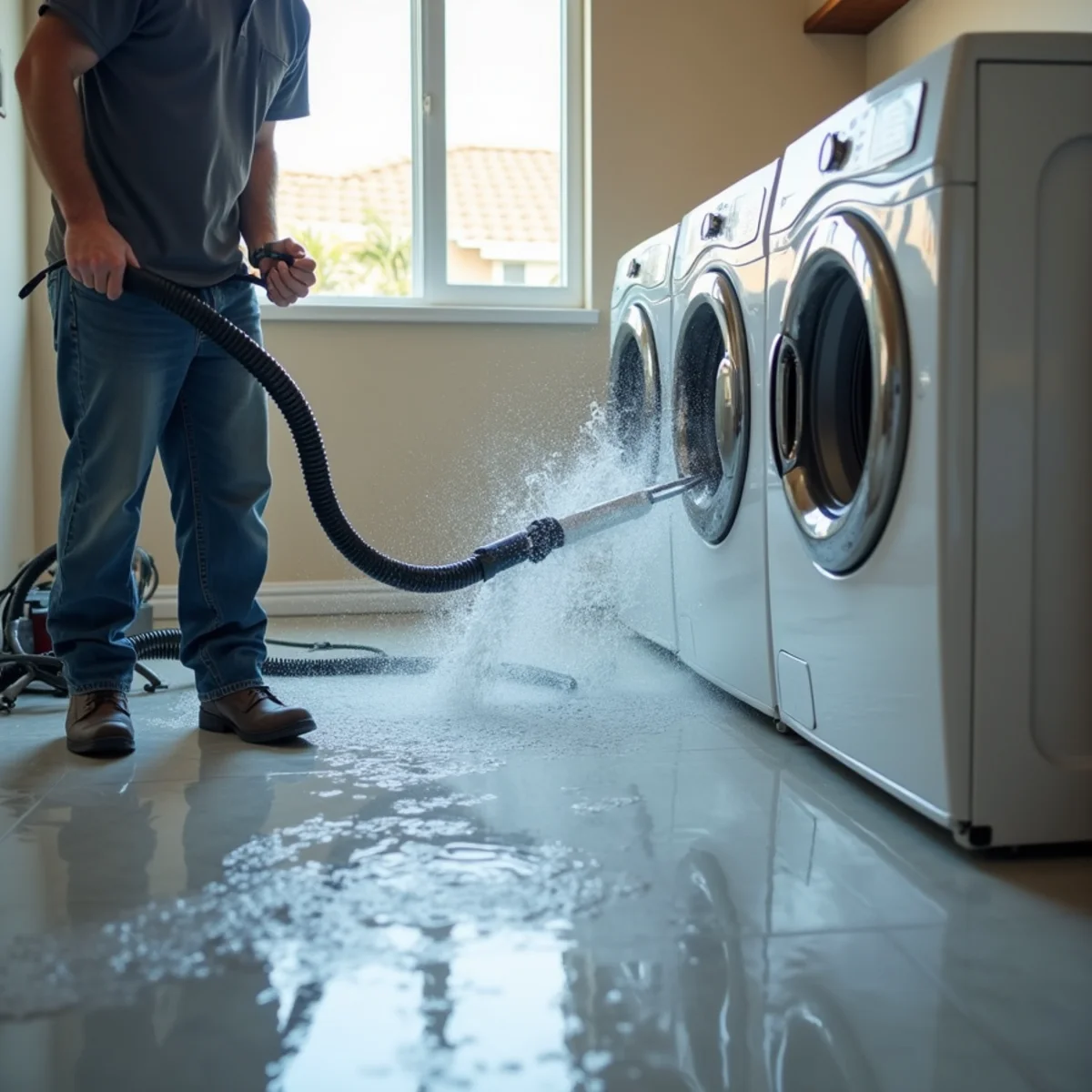
Washing machine supply lines are pressurized 24 hours a day, whether the machine is running or not. That's exactly why a burst hose is one of the most damaging plumbing failures a home can have — it doesn't wait for you to start a load. A worn rubber hose or a corroded fitting can let go while you're asleep or at work, and by the time someone finds it, the laundry room floor, the wall behind it, and often the room next door are all soaked.
1. Shut off both valves at the wall
Behind most washing machines are two valves — hot and cold — usually mounted on a box or plate on the wall. Turn both clockwise until they stop. If they're original to the house and haven't been touched in years, they can be stiff or partially seized; use steady pressure and don't force it hard enough to snap the handle. If the valves won't close, or you can't reach them because of water and debris, shut off your home's main water valve instead.
2. Unplug the machine before you do anything else
Washing machines sit on standing water fast once a hose fails, and the machine itself is plugged into a wall outlet at floor level in most laundry rooms. Unplug it at the wall — don't reach behind or under the machine while standing in water to do it. If the outlet itself is wet or partially submerged, leave it alone and shut off the breaker for that circuit instead.
3. Check where the water traveled — not just where you found it
Laundry rooms are almost always tucked next to a kitchen, garage, or hallway, and water from a burst hose spreads along the baseboard in every direction before it's noticeable. Check the following:
- Adjoining rooms. Water travels under shared walls and through door thresholds faster than most people expect.
- The floor below, if the laundry room is upstairs. A second-story laundry room with a burst hose is a common cause of a ceiling stain appearing in a room below within the hour.
- Behind and under the machine itself. Slide it out if you can do so safely, since water often pools directly underneath where you can't see it.
4. Extract what you can, then stop guessing
Towels and a wet/dry shop vac handle the surface water. But water that's gone under vinyl flooring, into the particleboard base of cabinetry, or through the wall to the room next door needs more than a mop — it needs extraction equipment and moisture readings to confirm it's actually dry, not just dry to the touch. Our water extraction team uses moisture meters to check the subfloor, baseboards, and adjacent walls, because surface-dry and structurally-dry are two very different things.
If water reached a finished room, a second-floor situation, or ran for more than a few minutes before anyone caught it, treat it like the burst-pipe emergency it is — our burst pipe cleanup service is built for exactly this kind of sudden, high-volume failure.
5. Document the failure and check the hose itself
Photograph the burst hose before you throw it away — insurers often want to see the point of failure for a sudden-discharge claim. While you're at it, look at the hose material: standard black rubber hoses typically last 3 to 5 years and are the most common ones to fail, while braided stainless-steel replacements last considerably longer and resist bursting under the same constant pressure. If your current hoses are the original rubber ones and more than a few years old, replacing them now — after this cleanup — is one of the cheapest prevention steps available.
A different problem: an overflowing drain standpipe
Not every washing machine flood is a supply-line burst. Sometimes the culprit is on the drain side instead — the standpipe the machine's drain hose empties into gets clogged with lint and detergent buildup, and during the drain cycle, water backs up and spills over the top of the standpipe onto the floor. This looks similar to a supply-line failure at first glance but has a different fix, since there's no valve to close — the machine is simply emptying into a blocked pipe. If your machine drains into a wall-mounted standpipe rather than a floor drain, and the flooding happened specifically during or right after the spin cycle rather than as a constant flow, a clogged standpipe — not a burst hose — is the more likely cause, and it's worth mentioning to whoever comes out to fix it.
Why this happens more in Chino Hills laundry rooms than you'd expect
Home water pressure across the Inland Empire runs higher than many hose manufacturers design for, and hard water accelerates the internal corrosion of the metal fittings crimped onto rubber hoses. Combine that with hoses that are rarely inspected because they're tucked behind a machine, and it's a predictable failure point — especially in homes in Rolling Ridge and similar neighborhoods where many houses still have their original builder-installed hoses years past the recommended replacement window.
If your washing machine hose has burst and water is spreading, call (201) 277-9344 now — we run 24/7 and can get extraction equipment on site fast enough to keep this from becoming a wall and subfloor replacement.
Frequently asked questions
How much water can a burst washing machine hose release?
Should I replace both washing machine hoses if only one burst?
Is water damage from a burst washing machine hose covered by insurance?
Water Damage Chino Hills
A local, IICRC-certified restoration team serving Chino Hills and the Inland Empire 24/7. Water damage right now? Call (201) 277-9344.